
What a Vulnerability Assessment Costs, and Where the Range Comes From
Contents
Ask two providers and the same "web application assessment" can come back at ¥300,000 from one and ¥3,000,000 from the other. Neither quote is wrong.
They are counting different things, and once those things are matched the numbers become comparable.
The bands are set by method, and they overlap
Tool-led work runs ¥300K–1M and expert manual testing ¥1M–5M+, according to pricing Japanese providers publish themselves. Because the bands overlap, lining up figures says nothing about what each quote actually covers.
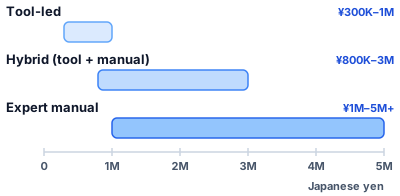
Figure 1: Cost bands by method — every band overlaps at least one other
Four decisions multiply into the quote
What is assessed, the unit counted, how deep the testing goes, and what follows the report. Those four differ by provider, and depth moves the number more than the other three.
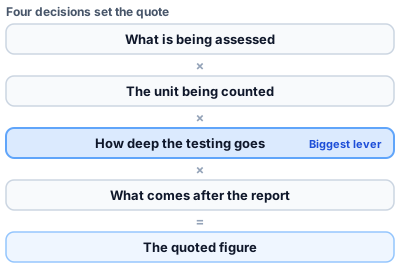
Figure 2: The four multiply rather than add — widening one moves the whole figure
Deep dive: what each of the four changes
What is being assessed. Inspecting how a web application is built, checking OS and middleware configuration against known flaws, testing a mobile app, or reviewing cloud permissions are different work. The ranges above are for web application assessments; change the layer and a different quote applies.
The unit being counted. Screens, requests, or FQDNs — the same system yields a different multiplier depending on which one the provider uses. For a service with a large authenticated area, this variable alone can roughly double a quote.
What comes after the report. A report alone, a window for follow-up questions, or a re-test after remediation are priced differently. Handing over raw tool output versus having a person strip false positives and attach reproduction steps also changes the labour, and a re-test billed separately means budgeting twice before anyone can confirm the fix worked.
Depth is set by what the customer supplies and what gets scoped in
Covering only what is reachable anonymously, versus being issued test accounts and walking the authenticated screens. The more that is provisioned and handed over, and the more classes of check that are scoped in, the more the work depends on people.
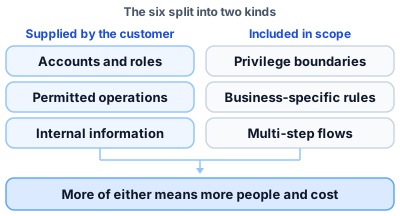
Figure 3: The six factors split into what the customer supplies and what gets scoped in
Deep dive: what each factor establishes
Which accounts and roles are provisioned. Ordinary user against administrator, or two tenants on separate contracts — the number of roles changes the workload, and multi-factor authentication or single sign-on adds setup effort of its own.
Whether privilege boundaries are probed. Can one user's identifier be swapped for another's and return their data? Can an ordinary account reach administrative functions? Two accounts and a comparison will establish it, but every additional role multiplies the pairs worth testing.
Whether rules specific to the business are in scope. An order accepted after a price or quantity was edited; a confirmation reached with a step skipped. Each is a well-formed request, and only that business's rules make it a defect, which is one of the reasons manual testing costs what it does.
Whether multi-step flows are followed. Cart to payment to confirmation carries state across many requests, and probing endpoints one at a time never walks that path.
Which operations are permitted. Creating and modifying test records is routine in an authenticated assessment, while irreversible action and load testing tend to be negotiated separately, and whether the work runs against production or an equivalent environment moves the number again.
How much internal information is shared. Specifications, design documents, API definitions, and source push testing further into places black-box probing struggles with: concurrency races and cryptographic misuse are typical examples.
An annual assessment cannot confirm what changes before the next one
Run once a year, an assessment confirms the state of the system at that moment and leaves roughly a year unconfirmed. During that window assets accumulate, new vulnerabilities are disclosed, and the system itself changes.
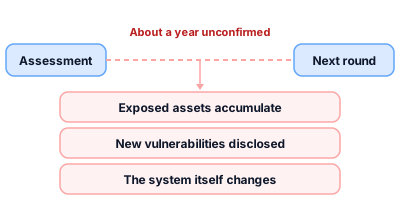
Figure 4: What moves between one assessment and the next
This is not an argument against assessments, because looking deeply requires people. It is an argument that looking deeply and looking often are different jobs, and neither substitutes for the other.
Deep dive: how each of the three lands
Assets accumulate. Subdomains stood up by individual teams, a staging server left reachable, domains inherited through an acquisition. None of them existed at the last assessment, so none appear in the report.
Vulnerabilities accumulate. Without a single line of code changing, a newly disclosed flaw in a shipped dependency turns a server nobody had flagged yesterday into a known target today. A configuration that passed cleanly in January can be exploitable by April.
The system itself changes. Features added, settings altered, permissions reworked, external services connected. Only part of that is visible from outside, and how the privilege boundaries or business rules were reshaped cannot be judged externally at all.
Continuous coverage is priced differently and confirms different things
Continuously discovering and monitoring internet-facing assets is sold as attack surface management and priced monthly: self-serve offerings start in the tens of thousands of yen per month, and those bundling analyst-led operation run above ¥100,000. Annualised, that sits in a different band from a single mid-size assessment.
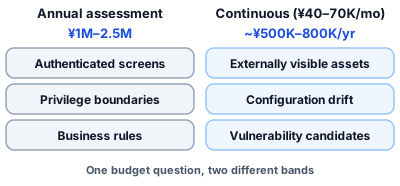
Figure 5: The bands differ, and so does what each one confirms
What deserves comparison is not the figure but what the figure confirms.
Deep dive: where continuous monitoring stops
"Candidates" is deliberate: detection and validation are separate steps. Confirming that an attack actually succeeds is a CTEM capability at PentaTrail, applied only to findings that qualify.
Externally observed monitoring watches what is reachable without authenticating. Paths that require a login are recorded as requiring one, and nothing goes past that point. Systems reachable only from inside the network, source and dependency inventories, employee endpoints, identity providers and cloud control planes stay out of scope unless a separate integration is set up. Where the line falls is drawn out in ASM, vulnerability assessment, and penetration testing.
A quote without a settled scope grows later
Lining up figures is not a comparison; matching the unit, the depth, and the post-report support is what makes "expensive" and "cheap" mean something. Scoping against everything the organisation exposes takes an inventory of what is visible from outside.
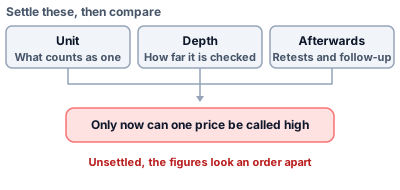
Figure 6: Until these match, the figures cannot be compared
PentaTrail is ¥40,000/month for ASM and ¥68,000/month for CTEM, with the price and the included scope both published before signup. A 14-day trial returns the inventory of what is externally visible for your own domains.
Appendix: the published cost tables
Table 1: Cost by assessment method (market estimate based on published Japanese pricing)
| Method | Typical cost |
|---|---|
| Tool-led (automated scanning) | ¥300K–1M |
| Hybrid (tool plus manual) | ¥800K–3M |
| Expert manual testing | ¥1M–5M+ |
Running a free scanner yourself sits outside this table; these are the figures for commissioning a provider. The ranges are wide because providers assume different target sizes.
Table 2: Cost by target size
| Target | Typical cost |
|---|---|
| Small site (20–30 pages) | ¥300K–800K |
| Mid-size web app (100–300 pages, authenticated area) | ¥1M–2.5M |
| Large e-commerce or system-integrated platform | ¥3M and up |
The bottom row is defined by complexity rather than page count, so it overlaps the page-count bands. These are per-assessment figures; run one a year and that is the annual line item.
Table 3: What each spend actually confirms
| Form | Cost | Mainly confirms |
|---|---|---|
| Mid-size web app assessment (annual) | ¥1M–2.5M | Authenticated screens, privilege boundaries, business-specific rules (when scoped in) |
| Continuous monitoring (at ¥40K–70K/month) | ~¥500K–800K/year | Externally observable assets, configuration drift, vulnerability candidates |
Cost ranges are compiled from pricing that Japanese vulnerability assessment providers published as of 4 August 2026. Actual quotes vary with scope and method. PentaTrail figures are our own published prices.
Visualize your attack surface with PentaTrail CTEM/ASM
From discovery to vulnerability validation and remediation — all powered by the CTEM framework.
Get Started