

The Fix Window Has Closed — Why 'Find It, Fix It Fast' Is the 2026 Default
Contents
"Once a vulnerability goes public, how long do you have to fix it?" The answer has changed dramatically in the last few years: it used to be weeks, then days.
For internet-facing devices, there are now cases where the gap has all but disappeared. What follows walks through what the public data actually demands.
For internet-facing devices, the gap between disclosure and exploitation is essentially gone
Verizon's 2025 Data Breach Investigations Report looked at 17 vulnerabilities in internet-facing devices such as VPNs and firewalls, and found a median of zero days between CVE disclosure and the vulnerability appearing on the catalog of confirmed exploited flaws (CISA KEV).
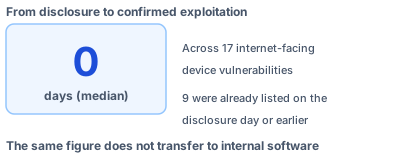
Figure 1: Days from disclosure to confirmed exploitation (Verizon DBIR 2025)
Deep dive: the scope this number covers
Nine of the seventeen were already on the catalog on the day the CVE published, or before it. Exploitation was a live problem essentially at the moment of disclosure. It matters that the scope is limited to internet-facing devices; the same figure does not transfer to internal software generally.
Intrusions concentrate on the devices visible from outside
Japan's National Police Agency reported that in the first half of 2025, 84% of ransomware cases where the intrusion route was identified came in through externally exposed devices such as VPN appliances and remote desktop.
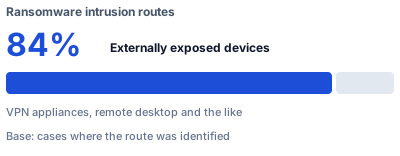
Figure 2: Breakdown of cases with an identified intrusion route (National Police Agency, H1 2025)
Deep dive: unpatched flaws are not the only thing being used
Leaked credentials and misconfiguration come through the same doors. The picture is that the opening visible from the internet gets tried well before anything exotic. What an attacker is looking at is not your asset register but what is actually visible from outside.
Assets you didn't know about are an ordinary intrusion route, not an edge case
In a Trend Micro and CSO Online survey, 73% of security leaders said they had experienced an incident originating in an asset they hadn't known about or wasn't under management.
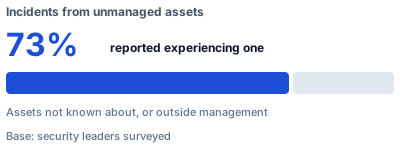
Figure 3: Rate of incidents originating in unmanaged assets (Trend Micro / CSO Online 2025)
Deep dive: where the growth comes from
Cloud migrations, subdomains stood up per department, a server exposed briefly for testing. How they accumulate is covered in our piece on shadow IT, and how to enumerate them from outside in our piece on ASM.
With all three true at once, an annual assessment cannot structurally keep up
The way in is an externally visible asset, some of those assets are ones nobody listed, and the weakness gets attacked at roughly the moment it publishes. Between one assessment and the next, assets appear, vulnerabilities publish, and exploitation can begin.
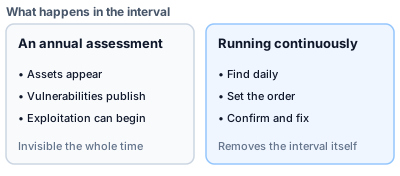
Figure 4: What can't keep up is the interval, not the capability
Deep dive: which is why it becomes a loop
Discover external assets continuously, order them by danger, confirm whether they are genuinely exploitable, and fix them through. Running that loop to shrink the attack surface is what CTEM describes. Rather than one inspection, it removes the interval.
Order by exploitability, not by severity
Hundreds of findings a week is realistic, and nobody gets to all of them. Some high-severity flaws are never targeted, and some middling ones have confirmed exploitation.
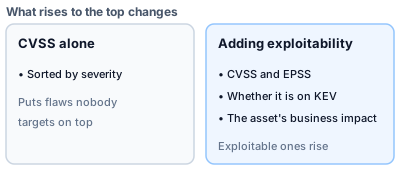
Figure 5: Ordering by severity alone versus ordering with exploitability
Deep dive: there is a confirmation step after the ordering
A stage that narrows a scanner's candidates down to the ones genuinely exploitable comes next. How to read the individual scores is in CVSS, EPSS and KEV, and the confirmation stage in Validating vulnerabilities with AI.
What has to rise is both noticing fast and fixing fast
With the gap gone, one without the other does not arrive in time. PentaTrail scans daily, orders by exploitability, and carries through to turning the fix into a concrete task.
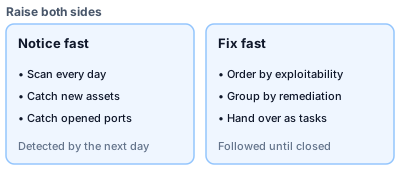
Figure 6: Raising the noticing side and the fixing side together
- What is CTEM? How it differs from traditional vulnerability management
- What is Attack Surface Management (ASM)?
- CVSS, EPSS and KEV: how to read each score and when to use it
- Connecting CTEM data to AI agents over MCP
Seeing how your attack surface looks from outside right now is free to try for 14 days.
Appendix: the public data cited, and what PentaTrail covers
Table 1: the figures used above, and their sources
| Figure | What it measures | Source |
|---|---|---|
| Median 0 days | Days from CVE disclosure to KEV listing across 17 internet-facing device vulnerabilities | Verizon DBIR 2025 |
| 9 of 17 | Already listed on the day of disclosure or earlier | As above |
| 84% | Share of ransomware cases with an identified route that entered via externally exposed devices | National Police Agency, H1 2025 |
| 73% | Share of security leaders reporting an incident from an asset they hadn't known about | Trend Micro / CSO Online 2025 |
Table 2: what PentaTrail covers
| Capability | Detail |
|---|---|
| Daily scanning | New assets and newly opened ports are detected by the following day |
| Ordering by exploitability | Not CVSS alone, but combined with KEV, EPSS and the asset's business impact |
| AI remediation guidance | Groups many findings by remediation approach and turns them into concrete tasks |
| Access from an AI agent | Your attack surface data can be queried directly |
If the attacking side is raising its speed through automation, the defending side has no option but to answer in the speed of its judgment and its execution. With the window gone, the answer is not periodic inspection but continuous sight and fast repair.
The scan cadence was checked against PentaTrail's scheduled-job configuration on 2026-08-17.
Visualize your attack surface with PentaTrail CTEM/ASM
From discovery to vulnerability validation and remediation — all powered by the CTEM framework.
Get StartedRelated Articles

Discovery Alone Won't Protect You: Confirming "Can It Actually Be Exploited?" with AI Deep Scan

What is the Threat Discovery Level (TDL)? Ranking vulnerabilities with CVSS × EPSS