
What is CTEM? A Complete Guide to the 5 Phases
Contents
CTEM (Continuous Threat Exposure Management) is a security framework introduced by Gartner in 2022. It describes discovering, assessing, and remediating an organization's attack surface continuously, from the attacker's perspective.
The goal — fewer exploitable weaknesses — is the same as traditional vulnerability management. The shape of the work is not.
CTEM widens the scope and the decision material, and keeps five steps cycling
Vulnerability management has commonly centred on periodic scanning of known assets and remediation. CTEM broadens both the scope and the material the decision rests on, including redrawing the scope from the attacker's side, and the five steps keep cycling.
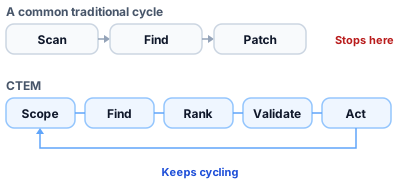
Figure 1: An operation that reaches a milestone, against one that keeps cycling
Each of the five steps produces something different
Set the scope, find the assets, rank them, test what is really exploitable, drive the fix. The single phrase "vulnerability management" hides the fact that each step hands over a different deliverable.
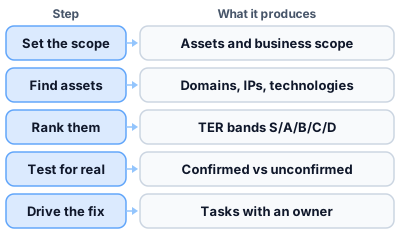
Figure 2: Each CTEM step, and what PentaTrail hands over at it
Deep dive: what each step actually involves
1. Scoping. Define the assets and business risks that need protection, going beyond IT assets to include SaaS applications, cloud environments, and supply chain dependencies. In PentaTrail this means registering your origin domains and applying BI tags (purpose, data classification, availability) to each asset. See Business Impact (BI) Score for details.
2. Discovery. Automatically discover all assets within the defined scope — domains, subdomains, IP addresses, ports, technologies, cloud storage, and anything else an attacker could find. Previously unmanaged assets that surface here are visualised as shadow IT risk. See ASM: A Beginner's Guide and Shadow IT.
3. Prioritization. Assign priority to discovered threats based on business impact and exploitability. PentaTrail derives the TDL (Threat Discovery Level) from CVSS and EPSS, derives the BI Score from asset tags, and combines both into the TER band (S/A/B/C/D). See TER, TDL, and CVSS, EPSS, and KEV.
4. Validation. Verify whether high-priority threats are actually exploitable. PentaTrail's AI Deep Scan combines industry-standard detection templates with AI guidance to actively validate high-priority findings, classifying them as confirmed or unconfirmed. Results feed back into the TER band in two directions: confirmed findings retain Evidence Grade A, and unconfirmed findings get their TDL lowered by one level.
5. Mobilization. Execute remediation based on validation results. PentaTrail generates AI remediation guidance per finding and breaks the work into tasks assigned to owning groups and individuals. Executives receive a weekly AI-summarised insight that surfaces remediation progress and shifts in risk posture at a glance.
Five things change: perspective, scope, frequency, prioritisation, validation
Five things separate it from the typical operation. It looks from outside as an attacker rather than scanning from within, and covers cloud and SaaS rather than only known IT assets. It runs continuously rather than quarterly, weighs business impact rather than CVSS alone, and establishes exploitability rather than stopping at scan output.
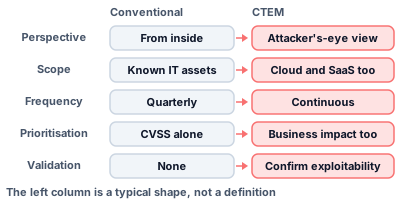
Figure 3: What swaps places on each of the five axes (the full comparison is in the appendix)
What made it necessary is that the ground to defend moved outside
Cloud migration, remote work, and SaaS adoption pushed what has to be defended past the internal network. Keep defending the perimeter alone and the count of assets nobody tracks simply grows.
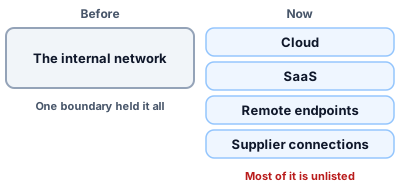
Figure 4: The ground to defend spread outward, and most of the new ground is unlisted
The window between disclosure and exploitation is also shrinking year by year, which quarterly scanning cannot keep pace with (exposure windows have closed). Since treating every vulnerability with equal urgency is not affordable either, the work is to identify what is genuinely dangerous and concentrate limited people there.
PentaTrail carries a capability for each of the five steps
PentaTrail/CTEM is designed around this framework, running scope registration, discovery, TER-band prioritisation, AI Deep Scan validation, and AI remediation guidance with owned tasks as one service.
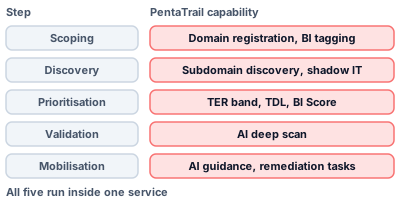
Figure 5: The capability that covers each step (deep-dive articles are in the appendix)
To get started with continuous attack surface management, start your 14-day free trial.
Appendix: the full comparison, and capabilities by step
Table 1: CTEM against traditional vulnerability management
| Aspect | Traditional VM | CTEM |
|---|---|---|
| Approach | Internal scanning | Attacker's perspective |
| Scope | Known IT assets | All assets including shadow IT, cloud, SaaS |
| Frequency | Periodic (monthly/quarterly) | Continuous, real-time |
| Prioritization | CVSS score-based | Business impact + exploitability |
| Validation | None (scan results only) | Actual exploitability testing |
| Response | Patch-centric | Cross-functional mobilization |
The left column describes a typical operation, not a definition of vulnerability management. Programmes built around periodic scanning may well include prioritisation and validation of their own.
Table 2: PentaTrail capabilities by step, with deep-dive articles
| Phase | Main PentaTrail capabilities | Related articles |
|---|---|---|
| Scoping | Origin domain registration, BI tagging on assets (purpose, data classification, availability) | BI Score |
| Discovery | Automatic subdomain discovery, port and technology stack detection, shadow IT visualization | ASM Beginner's Guide / Shadow IT |
| Prioritization | TER bands (S/A/B/C/D), TDL, BI Score, KEV boost, Evidence Grade | TER / TDL / CVSS, EPSS, KEV |
| Validation | AI Deep Scan, TDL adjustment based on confirmed/unconfirmed status | AI Deep Scan |
| Mobilization | AI Remediation guidance, task management, AI weekly insights | (Dedicated article to follow) |
Visualize your attack surface with PentaTrail CTEM/ASM
From discovery to vulnerability validation and remediation — all powered by the CTEM framework.
Get StartedRelated Articles

The Fix Window Has Closed — Why 'Find It, Fix It Fast' Is the 2026 Default

NVD Is Scaling Back Its Own CVSS Scoring: Is This Cause for Alarm?