
Your Unseen Assets Are
Your Greatest Vulnerability
Domains, IPs, ports, cloud buckets exposed to the internet — the assets missing from your inventory are the first targets attackers seek. PentaTrail monitors your attack surface continuously, from an attacker's perspective.
Blind Spots
Three Blind Spots Organizations Face Today
Invisible External Assets
Cloud migration, M&A, departmental subdomains — IT asset inventories alone can't capture the full picture of your external exposure. What attackers can see, you cannot.
Key-Person Dependent Security
Scan result interpretation, priority decisions, executive reporting — all depending on specific individuals. When people change, so do response quality and risk judgments.
Risks You Can't Explain
When the board asks "Are we secure?" — can you answer with quantitative evidence? Organizations need the ability to explain risk with numbers, not intuition.
CTEM Framework
Gartner's 5-Stage Process, Fully Implemented
CTEM (Continuous Threat Exposure Management) is a framework proposed by Gartner in 2022 for continuously discovering, evaluating, and remediating externally visible weaknesses. Rather than a one-time assessment, it shrinks your attack surface by repeating five stages.
Each stage maps to one of two plans. CTEM is the higher tier and includes everything in ASM. ASM (attack-surface management) = asset discovery, vulnerability detection and risk rating (TER), and reading the AI remediation guidance. CTEM adds business-impact asset weighting & grouping (prioritization), validation, remediation task workflow, and executive reporting. Each stage shows which plans it's available in.
Exposure management comes down to three questions — discoverability (attack surface), susceptibility (vulnerabilities), and exploitability (validation). The five stages below are how you work through them continuously. PentaTrail covers discoverability and susceptibility with ASM, and adds exploitability (validation) with CTEM.
The concept itself is explained in What is CTEM?, and the asset-discovery side in ASM (Attack Surface Management).
Scoping
Register your target domains and define the monitoring scope
Build an operational structure with groups and assigned owners
Discovery
Daily discovery of external assets across 7 categories
Hosts, IPs, ports, tech stacks, URLs, cloud buckets, and WHOIS / DNS. Nine OSINT APIs refresh every day.
Prioritization
Weight assets by business impact (BI Score) and group them by division or subsidiary. The same risk (TER) is a different priority for a payment system vs. a test environment
Beyond CVSS alone — priority combines EPSS (exploit-probability prediction), KEV (known exploited vulnerabilities), and business impact (BI Score). Same CVSS, different priority for payment vs. test systems
Validation
Recon tooling + AI-generated templates prove exploitability without disruption
AI-generated templates + Nuclei engine. Evidence Grade for confidence
Mobilization
Reading the AI remediation guidance is in ASM; owner assignment, task workflow, and executive reporting are in CTEM, tracked to closure
Owner assignment, deadlines & progress tracking to ensure completion
Based on Gartner, "Implement a Continuous Threat Exposure Management (CTEM) Program" (2022)
Why PentaTrail
Discovery Alone Is Not Enough
Most ASM products stop at asset discovery and vulnerability detection. PentaTrail goes further, covering all five CTEM framework stages — from validation through remediation to executive reporting — in a single solution.
The ASM plan covers asset discovery, vulnerability detection and risk rating (TER), and reading the AI remediation guidance. The CTEM plan adds business-impact asset weighting & grouping (prioritization), validation, remediation task workflow, and executive reporting — covering everything.
Deterministic Discovery
No AI ambiguity
DNS, CT Logs, WHOIS, reverse IP — we combine internet protocols and OSINT for deterministic asset discovery. No reliance on AI inference; only technically verified results.
Daily Scanning
Never miss a change
Most ASM services scan monthly or weekly. PentaTrail runs automated daily scans, detecting new assets and service changes by the next day.
Non-Destructive Safety Guards
Security by architecture
Scans are limited to domains verified by DNS ownership proof. Deep scans only run non-destructive checks — no operations that could impact your systems are ever used.
AI-Native Architecture
Designed by security practitioners, built with AI
Architected from CSIRT and governance operations, implemented entirely with generative AI. Discovery stays deterministic; AI powers what comes after — vulnerability templates, remediation guidance, and executive summaries as core capabilities.
MCP Server
An ASM that plugs into AI agents
An MCP server out of the box. AI agents you have approved pull vulnerability data from PentaTrail and automate the hand-off to SIEMs, ticketing systems, and remediation workflows — a native building block of the AI ecosystem.
Features
End-to-End External Attack Surface Management
All five CTEM stages in a single platform
Discovery, detection, and risk rating plus reading AI remediation guidance are in the ASM plan; weighting & grouping (prioritization), validation, remediation workflow, and executive reporting are in the CTEM plan.
Automated Asset Discovery
Hosts, IPs, ports, tech stacks, URLs, cloud buckets, and DNS — 7 asset categories surfaced by 9 OSINT APIs and refreshed daily in your inventory.
Vulnerability Scanning
Detect vulnerabilities through DAST and SSL scanning, then automatically rank them by risk (TER: S/A/B/C/D).
Change Detection
Detect new assets, service changes, and port openings daily. Score trends let you quantify how your security posture has improved over time.
Continuous Security Management
Group assets by division or subsidiary and assign owners. AI generates per-vulnerability remediation steps and correlated-risk analysis, tracked to closure by the management-maturity score.
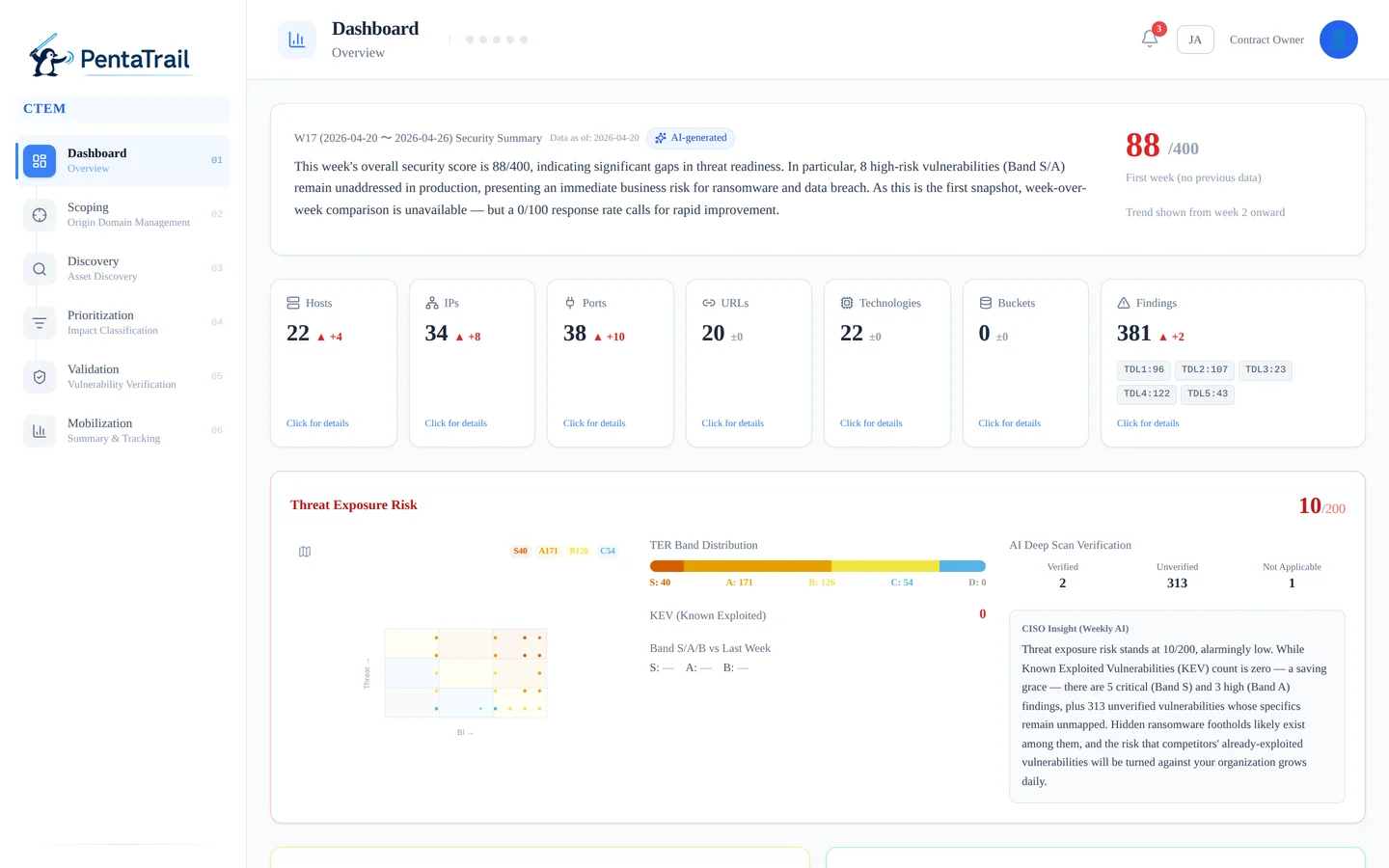
Dashboard
Intuitive Dashboard
Get a complete view of your attack surface at a glance
Ready to See Your Attack Surface?
Register in as little as 5 minutes — see your first attack-surface results within hours. 14-day free trial.
Start Your 14-Day Free TrialUse Cases
Attack Surface Management for Every Scenario
For any organization that needs to manage its external attack surface
Continuous ASM
Discover shadow IT and unmanaged subdomains across 7 asset categories. Track management-maturity score over time and continuously reduce risk before incidents occur
Cloud Exposure Check
Surface cloud buckets and unintended public resources across AWS, GCP, and Azure. Business-impact scoring prioritizes the highest-risk items first
M&A Due Diligence
Discover acquisition targets' external assets comprehensively and validate vulnerabilities with AI deep scanning. A single score report surfaces IT risk for executive review
Small-Team Security Operations
AI auto-generates per-vulnerability remediation steps and priorities. Even a one-person IT team can run continuous attack-surface management — no specialist expertise required
Pre-Launch Check
Validate new services and APIs before launch with AI deep scanning. Detect information exposure and misconfigurations non-destructively, with auto-generated remediation steps
Post-Incident Reassessment
Re-inventory your attack surface across 7 asset categories after an incident. BI score × threat level identifies breach scope and quantifies prevention priorities
Audit & Certification
Auto-update asset inventories for ISMS, SOC 2, and other audits. Management-maturity scores and remediation history serve as ready-to-submit continuous-evaluation evidence
Third-Party Security Assessments
Answer security assessments from customers and parent companies with objective evidence of your own external exposure. Support your preparation for rising requirements — such as Japan's SCS assessment scheme — with continuous visibility
Quarterly Executive Report
Report quantitatively with business-impact (BI) score distribution and score trends. Explain security ROI to leadership in numbers, not gut feeling
Threat Landscape
The Numbers Tell the Story
Intrusion via External-Facing Devices
Over 80% of ransomware breaches originated from external-facing devices such as VPN appliances and remote desktop services
Surge in Edge Device Exploitation
Vulnerability attacks targeting external-facing devices like VPNs and edge appliances surged over 7x year-over-year. Zero-day exploitation observed
Source: Verizon DBIR 2025
Incidents from Unmanaged Assets
Over 70% of security leaders reported experiencing incidents caused by previously unknown or unmanaged assets
Source: Trend Micro / CSO Online (2025)
Exploited on Day One
For the edge-device vulnerabilities DBIR analyzed, the median time from disclosure to the start of mass exploitation was zero days — no grace period for leaving exposure unaddressed
Source: Verizon DBIR 2025
Why Now
Supply-Chain Pressure Is Rising
Attackers increasingly target smaller organizations and reach in through suppliers, and customers increasingly ask for objective evidence of your security posture.
Third-Party Assessments Are Becoming Formalized
Japan's METI is launching a Supply Chain Security (SCS) assessment scheme by the end of FY2026, giving participating organizations objective star-rated levels to demonstrate their security posture.
Source: IPA / METI
Smaller Orgs and Suppliers Bear the Brunt
69% of ransomware cases hit organizations with 11–1,000 employees (Coveware Q4 2025), and third-party involvement in breaches doubled year-over-year (Verizon DBIR 2025) — external exposure matters regardless of size.
Source: Coveware Q4 2025 / Verizon DBIR 2025
Pricing
ASM
Know — discover, monitor, rank by risk
CTEM
Verify, act, and report
Downloads
Download our materials
Everything on the service, pricing, and company — free to download, no sign-up required.
Research
At Pentacon Research, Inc., we think about and publish on the technology, organizations, management and society around cybersecurity, drawing on our own research and conversations with practitioners.
Japan External Attack Surface
A monthly observation of Japanese companies’ email authentication, website CMS and website certificates, using only information anyone can see from the internet.
View the researchMore on CTEM and ASM
What the terms mean, how prioritization works, and how validation is done.
- What is CTEM? A Complete Guide to the 5 Phases
- ASM (Attack Surface Management) — A Beginner's Guide
- Shadow IT: How to Surface and Manage the Risks You Can't See
- Discovery Alone Won’t Protect You: Validating Exploitability with AI Deep Scan
- Threat Exposure Risk: Integrating Technical Risk and Business Risk
Start Managing Your Attack Surface, One Domain at a Time
ASM $290 / CTEM $490 — start your 14-day free trial and deploy the CTEM framework immediately.
Start Your 14-Day Free Trial