
Where Defenders Stand Now Vol.1 · Part 2
Does Human in the Loop Really Mean a Human Approves?
— Change management in the AI era, and designing the boundary of what to delegate
Interviewed September 9, 2026 · Published November 12, 2026
In Part 1, we saw that even if AI can write fix code, that doesn't mean the change can be applied safely.
So can we hand the testing and change management that follow over to AI as well?
In Part 2, we look further ahead.
There are systems whose testing can be automated, and systems whose testing can't
Kanai: I don't think most companies live in a world where that verification procedure is 100% automated.
All the required functions have been identified, and they've been turned into test code. Run it, and you can confirm that the system works normally across the board.
If you had gotten that far, you could create a patch with Patching as a Service and run it straight through the test cycle.
But in reality, that isn't how things are.
And building tests once isn't the end of it. Every company's systems keep being developed and keep changing. The tests have to keep changing along with them.
What's more, the effort to go from 99.9% to 100% costs an enormous amount. Testing everything 100% is difficult in itself.
At some point, you draw a line as a business decision and ship.
If AI and automation can solve that well, I think the patch cycle will move rapidly toward automation.
But as systems keep changing, you have to keep maintaining the tests, too, and we still don't know how far automation can go. I don't think it's easy.
Hiradate: With patching, too, I have a feeling that from now on things won't keep up unless we have AI test everything, including dependencies and defects, and keep the cycle going. Do you think that's doable?
Kanai: I think it will mean designing systems, from the moment you build them, on the premise that testing will be broadly automated.
The critical workflows that must keep running are defined, and tests have been written for all of them. With that in place, automation is easier.
But in a world where testing has been done by people and the test procedures are written in natural language or in paper specifications, automated patching won't work unless you replace that with automation.
If you built the system on that mechanism from the start, fine, but existing systems may have a pretty hard time.
Hiradate: So even if AI produces the patch, there are still many companies where the testing after that has to be done by people, based on specifications.
Kanai: I think there are.
Systems that provide an API and have API specifications are easy to automate, I think. But for systems with all kinds of users clicking around a GUI, automated testing is expensive.
Then people may say, "For the next three years or so, it's cheaper to keep having a testing company send people, like we always have," and it may be hard to switch.
Hiradate: Even tests where people interact with the interface to check that things work seem like they could be automated to a considerable extent using AI, don't they?
Kanai: Those can be used.
But if you try to automate even the things testers used to catch, like "the layout is broken," you need to build those tests from scratch. That becomes a new cost.
Do you persuade someone that "the layout doesn't really matter," or do you build proper tests?
The decision to change that also comes with responsibility.
For consumer products, some users might leave over a slight change in how things look. The person responsible for the business can't make that call easily.
"Is the human just an approver?"
Hiradate: I think the cycle of change is going to get shorter and shorter from here.
Until now, people reviewed changes and took responsibility for approving them. But that may no longer be fast enough.
If that happens, I think we may move toward delegating to AI to some degree, with humans defining "how much to leave to AI."
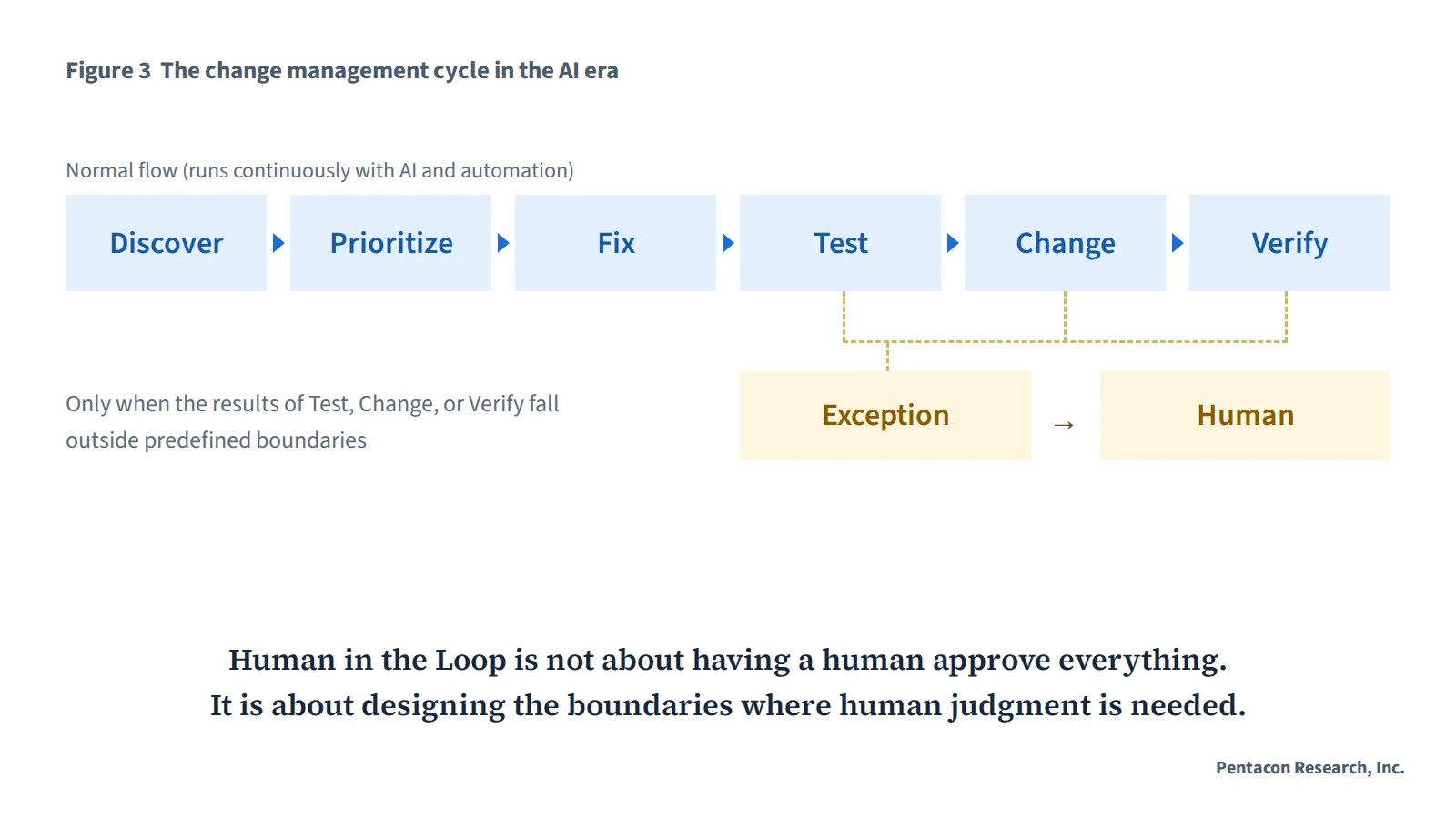
You often hear the phrase Human in the Loop, but I have a feeling that just saying a human should be in the middle doesn't solve anything.
First of all, if the volume is too large, humans can't review it all.
And when AI is running all the time and you can't tell whether what it tells you is really correct, being told "Please approve this" makes me wonder whether that is really approval.
If AI can produce something accurate, explain it in a way humans can understand, and we can make a judgment after understanding it, that's fine.
But if it just asks, on its own terms, "Is this OK?" and the human only clicks "OK," can you call that approval?
Kanai: That's right.
When you bring in AI, all kinds of work becomes automated. That raises the question of whether the human is just an approver.
In the case of vulnerability patches, the underlying problem is that you can't guarantee a patch will have no unintended effects.
When a patch is applied, the software vendor can't verify everything that will happen in the end user's environment.
In the end, the vendor releases the patch within the scope it has anticipated, and the possibility of business operations stopping remains.
So I think the structure in which the end user tests will remain.
Hiradate: I think we may need a design that uses AI but leaves the final decision to a deterministic gate.
Leave development and testing to AI, and depending on the conditions, have AI do even the PR approval.
Kanai: I think it will go in that direction.
But humans, too, have to keep thinking properly about what is happening within it.
We haven't reached a conclusion on that yet.
It isn't that once you bring in AI, humans can just sleep the whole time. If you slept the whole time, you might end up with something terrible.
While AI output and tests run automatically, I think at some point humans need to think about "what is working, and how."
When AI writes the code, how do people grow?
Kanai: One more thing that concerns me is people.
Today, at operating companies, end-user companies, and security companies alike, there are people who have built their careers doing the hard, unglamorous work of development and testing.
For a software engineer, you first learn to write code, then come to understand architecture, and then become able to do difficult performance tuning. There is that kind of career path.
But when AI automates coding and people no longer have to write code themselves, I worry that their thinking may become less detailed.
The same goes for testing.
If AI dramatically automates testing, people's thinking about testing may become less detailed, too.
Down the line, will there still be people who can design tests? Will people who can give AI appropriate instructions develop?
AI also sometimes returns answers that aren't appropriate.
When that happens, you need people who don't take the output at face value and can guide it appropriately, filling in the necessary methods and perspectives.
I don't think this is easy, either organizationally or in terms of developing people.
Today's AI can take over a good deal of a junior engineer's work. But not everyone who joins straight out of school can be a mid-level engineer from day one.
So how do you develop them?
Unless we solve that, we won't be able to sustain the organization.
That's why I tell our managers that I want them to think about career building at the same time.
"Govern AI from outside the AI"
At the end, the discussion moved to how to manage AI agents themselves.
Kanai: Once you give AI an AWS or Salesforce account and have it do work, it acts quite autonomously, unlike the systems we've had until now. So I think we'll need security controls different from what we've had.
For example, would you suddenly hand a new graduate the job of reorganizing the file servers of a company with 100,000 employees? You'd be too afraid to, wouldn't you?
Having the permissions alone isn't a reason to hand over the work.
You think, "This person can be trusted with work in this scope," and decide what they're allowed to touch. You keep records, too. Where necessary, you get confirmation in advance before proceeding.
I think AI needs that kind of mechanism as well.
If you write long conditions into the prompt, you may be able to control it to some extent. But that alone isn't enough.
Rather than governing AI from the inside, where the AI itself has control, I think we'll need mechanisms that govern it from the outside, where the AI has no control, with higher privileges.
We have to design mechanisms such as guardrails, sandboxes, audit trails, and approvals at a very fine-grained level.
It's still uncharted territory, and we're feeling our way, too.
The more AI agents enter companies' operations, the more I think we need to build the mechanisms for management, operation, and testing along with them.
AI is increasing the speed at which vulnerabilities are found and fixed.
At the same time, once you include testing, approval, developing people, and governing AI agents, there is still no established answer.
Right now, defenders are working out, in actual operations, how much they can leave to AI.
This conversation offered a picture of where defenders stand now.
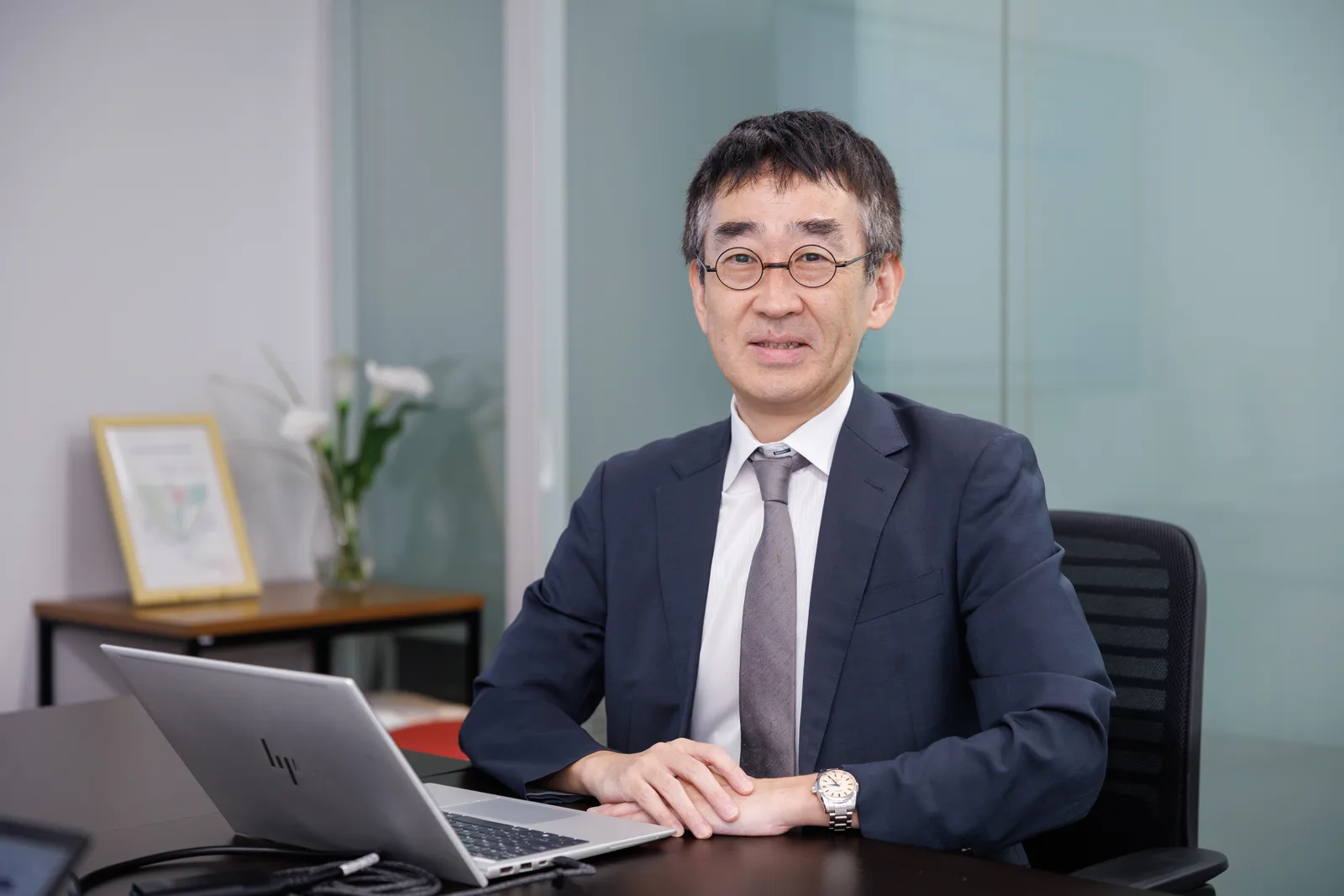
Ryoji Kanai
He worked on the development of the company's product yarai and, from 2020, served as head of its National Security Business Division. Today, as the executive responsible for technology across the company, he oversees its product business.

Kazuya Hiradate
Pentacon Research, Inc., CEO
After joining Nomura Research Institute, he worked at NRI SecureTechnologies across managed security services, CSIRT development, SOC establishment, zero trust, and security consulting. From 2017, he led the managed security services business, and from 2023, he served in a leadership role overseeing corporate cybersecurity management. He left the company in 2025 and founded Pentacon Research, Inc. in February 2026. He holds a graduate degree from Tokyo Institute of Technology.